
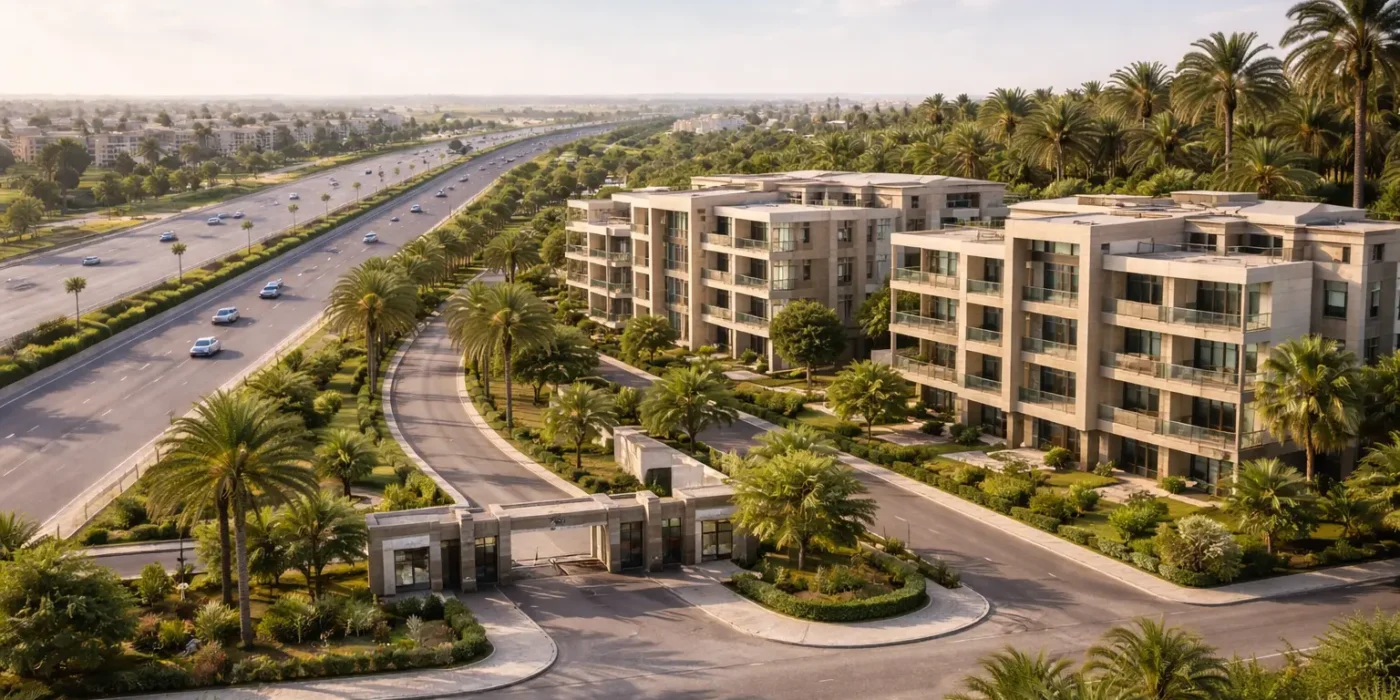
Many people hear about the Desert Road expansions and immediately connect them to Sheikh Zayed becoming more important overall. That idea sounds logical at first glance, but the reality is usually more nuanced than that.
Because real benefit is not measured only by how close a project is to the road, but by the nature of that proximity itself: Is access in and out easy? Does the connection to major routes genuinely support daily movement? Does the project still retain its quiet character? And does all of that clearly improve quality of life?
At that point, the more important question is no longer: Has the road improved? But rather: What do these expansions actually mean for you as a buyer or resident?
Why Is the Market Talking About the Desert Road Expansions in Sheikh Zayed?
In the past, many people viewed the Desert Road as simply a road connecting distant areas or shortening long travel times. But over time, that perception has changed, because its impact is no longer limited to traffic itself. It now extends to the way people evaluate a residential location in the first place.
Why Do Road Updates Affect the Property Buying Decision?
Because infrastructure does not remain just news on paper. In the end, it shows up in real daily routines. A buyer who commutes to work several times a week, takes children to school, or moves between Zayed and other parts of Cairo knows that even a small improvement in mobility can change the feel of the entire day.
A few minutes less on the way there and back may not seem significant in theory, but in practice they make a clear difference in comfort, reliability, and the energy left for the rest of the day.
From another angle, ease of access also shapes how the market views the unit itself. A unit in a location that is easy to explain and easy to reach may be more attractive at resale and easier to market for rent, simply because it serves everyday needs that a wider range of buyers and tenants can easily understand.
But Does That Mean Every Project in Zayed Has Become Stronger?
The benefits of the road expansions are not the same for every project. Some projects genuinely benefit because their locations are tied to real movement patterns, while others appear to benefit only in theory because they are “close” on the map, even though the daily experience in or around them does not reflect that image as strongly.
On the other hand, some projects may gain easier access, but at the expense of quietness or residential comfort if that proximity is too direct. So not every infrastructure improvement automatically means all locations have become equally strong.
Not Every Location in Sheikh Zayed Benefits in the Same Way
There is a major difference between a project that is close to a corridor that genuinely supports your daily life, and a project that is only superficially close to an important road on the map.
Real proximity is the kind that lets you move logically. You can get in and out without being forced onto poor roads, reach your usual destinations without unnecessary complications, and benefit from major routes as part of your routine, not just as a marketing feature in the project description.
That is why some locations feel strong because they are genuinely connected to routes people use every day: the road to work, a corridor that makes school access easier, or a practical connection to service areas and weekly essentials. This kind of proximity has a different value, because it is based on actual use, not just general impression.
A Project That Benefits from Access Without Direct Noise
A good location is not only close enough to benefit, but also far enough to preserve its residential character.
This is a sensitive point in Sheikh Zayed, because many buyers do not want to gain ease of movement only to lose privacy or quietness in return.
What is the value of a fast-to-reach location if the daily living experience is less comfortable? And what is the value of an address close to a major corridor if it puts you in constant contact with traffic pressure?
The better equation is usually a project that is connected to major routes in a practical way, yet sits within a more balanced residential setting. In other words, you benefit from access when you need it, and return to a project that still feels like a real home once your day is done.
A Project That Seems Perfectly Located… but Delivers Less in Daily Life
Some locations look very strong in marketing materials. The name is familiar, the road is nearby, and the description feels reassuring. But the real-life experience may reveal a different picture.
Access in and out may be less smooth than you expect. The roads around the project may be congested during peak hours in ways that weaken the advantage that looks so clear on the map. And you may find that being close to a major corridor does not necessarily translate into daily convenience, but sometimes into extra pressure or a weaker sense of calm.
That is where the difference appears between “a location that sounds good on paper” and a location that feels comfortable in daily use. And the smart buyer in 2026 is no longer satisfied with the broad image alone, but is increasingly focused on the practical details of life in and around that location.
A Smart Location Is Not the “Closest”… but the “Smartest”
In the end, a smart location is not measured only by a short distance or an attractive address.
It is the location that brings several elements together at once:
- Easy mobility without unnecessary complications
- A reasonable degree of residential privacy
- A sense of calm that protects the quality of the day
- Practical proximity to essential services
- A stronger ability to retain its appeal over time
So when you hear about the Desert Road expansions, do not think only in the traditional terms of: Who is closest?
A better question is: Who benefits the most in a balanced way?
What Do the Desert Road Expansions Mean for You as a Real Buyer?
Many buying decisions initially seem tied to big factors: the unit size, the look of the project, or the payment plan. But once you start living there, the small everyday details begin to take their true place.
A difference of ten minutes on a repeated trip is not measured once, but across months and years. Less time on the road may mean a calmer morning, an easier return at the end of the day, or a better ability to manage school runs, training sessions, weekly shopping, and family visits.
That is why when infrastructure improves, the effect is not only on the road itself, but on the overall sense of comfort. And real buyers usually notice that faster than anything else.
Ease of Access Has Become Part of a Unit’s Value
Today, a unit’s value is not tied only to what is inside it, but also to what surrounds it and how easily it can be reached.
A unit in an easy-to-reach location may appeal more strongly to a wide range of buyers because it speaks to a clear, practical need: a less complicated life. From there, ease of access becomes part of the location’s strength, whether you are buying to live there, thinking ahead to resale, or factoring rental potential into your future plans.
The key point here is that comfort is not a luxury detached from value. In many cases, it becomes part of that value.
Infrastructure May Make the Decision Clearer… but It Does Not Replace It
Still, it is important to keep the picture in perspective.
Road expansions are an important factor, yes, but they are not the only factor. A good decision is not built on the road alone, but on project quality, internal planning, the residential environment, the type of units available, and how clearly the developer’s vision comes through.
A road may give one location an edge, but it does not compensate for a poorly planned project. It may help boost the appeal of an area, but that alone is not enough to make every project within it suitable for every buyer.
How Do You Read the Impact of These Expansions on Any Project Before You Buy?
Before being influenced by a project title or a quick impression of its location, it is important to read the impact of the expansions in a practical, direct way. Because the real question is not simply: Is the road close? But: Will that proximity actually make your life easier while also preserving residential comfort and the long-term appeal of the location?
Ask About Real Access, Not Theoretical Proximity
When evaluating any project, do not settle for phrases like “close to a major corridor” or “minutes away from the road.”
Ask yourself simpler but more useful questions: Is access to the project genuinely easy? Do the surrounding roads serve daily routines in a logical way? What happens during peak hours? And does getting in and out feel smooth, or does the picture change once those trips become repetitive?
These questions do not require technical reading, but they help you understand the location as you will actually live it, not just as it is presented to you.
Ask About the Balance Between Movement and Quiet
The goal is not simply for a project to be connected, but for it to be connected without losing its residential character.
A balanced location lets you benefit from movement when you need it, then gives you something different once you are inside the project: reasonable calm, privacy, and an environment that makes coming home a comfortable part of the day, not an extension of the pressure outside.
If that balance is missing, the advantage of connectivity can turn into a daily burden, especially for buyers who place family living or everyday comfort high on their list of priorities.
Ask How This Location Will Feel Years from Now, Not Just Today
The smart question is not only: Is this location good now?
But: Will it still feel logical and attractive years from now?
Projects that benefit from infrastructure in a balanced way are often better able to retain their appeal. Ease of access is not a temporary advantage, but an element that can help sustain demand when it is paired with genuine project quality and a clearly defined residential environment.
Where Does Belva Compound Fit Into This Equation?

Once you understand the difference between a location that sounds good in the headline and a location that proves its value in daily use, it becomes natural to look at some projects from a more precise angle. That is where Belva Compound appears, not as an exception outside this analysis, but as an example through which it becomes easier to understand how the balance between accessibility, residential calm, and quality of life can shape the buying decision itself.
Why Does Belva Fit the Idea of a “Balanced Location”?
When you look at this equation, Belva Compound can be understood as a logical example of a project that does not rely only on the Sheikh Zayed name or on the theoretical idea of being close to key corridors, but on a more practical reading of what makes a location genuinely good.
The point here is not simply that the project is close, but that its location can be understood within a broader logic: benefiting from connectivity and movement while preserving a relatively calm residential character, which matters to the buyer who is not just looking for an address, but for a balanced living experience.
Benefiting from Movement Without Sacrificing Quality of Life
What makes this equation important is that many buyers in Zayed do not want a stark choice between two extremes: either a connected location that feels exhausting, or a quiet project that is less flexible in terms of movement.
In this context, Belva appears as an example of “practical connectivity + comfort + a balanced environment.” In other words, a project that can benefit from the advantages of its location within Sheikh Zayed without that benefit coming at the expense of everyday comfort or the residential character that drew people to Zayed in the first place.
Why Might This Equation Matter to a 2026 Buyer?
The 2026 buyer is more aware of details. It is no longer enough to hear that an area is strong or that the road has improved. They want to understand how that will actually affect their lives.
Is access easier? Will the daily routine become more flexible? Is the project suitable for real living, not just good in presentation? And does it retain a degree of appeal if the buyer later considers resale or renting it out?
That is why balanced projects feel more logical now, because they speak the language of real needs, not just general impression.
Belva Is Not Just Close to Zayed… It Offers a Smarter Reading of How to Live There
In the end, Belva’s presence in this type of analysis does not come across as direct promotion, but as an example that helps clarify the article’s core idea.
A project understood through the logic of a balanced location comes closer to what many buyers are looking for today: living in Sheikh Zayed, but with a smarter understanding of movement, quietness, services, and everyday quality of life.
That, in itself, is a point worth noticing more than any big headline or passing piece of news.
Do the Desert Road Expansions Make Buying in Sheikh Zayed a Smarter Decision?
Yes, the Desert Road expansions may strengthen Sheikh Zayed’s appeal and support a more positive reading of some locations within it. But that advantage is not distributed equally across every project.
The real beneficiary is usually the project that has positioned itself intelligently within the movement network and managed to combine ease of access with a comfortable residential nature. Projects that merely have a good-looking address from a distance may not deliver the same effect in daily life.
Real Value Appears When Access Meets Project Quality
The road alone does not create complete value.
The strongest value appears when good access is combined with thoughtful project planning, a comfortable residential environment, and a clear understanding of how people will actually use the place. Only then does infrastructure become a factor that strengthens appeal rather than just a temporary market headline.
That is why when a buyer thinks in 2026, they do not evaluate the road in isolation from the project. They look at the whole picture: How will I live here? And how will this choice continue to make sense over time?
That Is Why “Location Analysis” Has Become More Important Than Simply Hearing the News
Infrastructure news matters, but it does not create equal opportunity for everyone. It helps you read the market more intelligently and distinguish between a good address and a smart location, between a project that appears suitable from the outside and one that genuinely supports the way of life you are looking for. From that point on, location analysis becomes an essential step before buying, not just an extra detail.
Conclusion
The Desert Road expansions may strengthen Sheikh Zayed’s image and increase the importance of some locations within it, but they do not give every project the same advantage. The real difference does not lie in proximity alone, but in the type of proximity: Does it support daily movement? Does it preserve residential quietness? And does it give the project a practical advantage that can be felt over time?
If you are thinking about buying an apartment in Sheikh Zayed, the most important question today may not be: Where is the project located? But rather: How will this location serve you every day?
Frequently Asked Questions
Do the Desert Road expansions mean every compound in Sheikh Zayed has become better?
No, because the benefit varies from one project to another depending on its actual location and how it connects to major routes. Some projects may benefit clearly, while others remain less useful in everyday life despite their theoretical proximity.
How do road expansions affect the decision to buy an apartment in Sheikh Zayed?
They matter because they affect ease of movement and the time spent on daily trips. They can also make some locations more attractive for living, resale, or rental, provided the project itself is suitable.
What is the difference between a good location and a smart location in Sheikh Zayed?
A good location may be close to services or major routes. A smart location, however, combines ease of movement, quietness, residential character, and the ability to retain its appeal over time.
Do the Zayed expansions affect future property value?
They may help support the appeal of certain locations, which can influence how buyers view them in the future. But value is not determined by the road alone. It also depends on project quality, planning, the developer, and the nature of real demand in that location.
Is ease of access more important than price when buying an apartment?
There is no single answer that fits everyone, because the decision depends on your priorities. But ease of access is highly influential because it is directly linked to daily comfort and to how attractive the unit may remain later if you decide to sell or rent it out.
How could a project like Belva benefit from these expansions?
If the project enjoys a balanced location within Sheikh Zayed, the improvements may help support easier access and strengthen its appeal. The benefit becomes clearer when that advantage is paired with a comfortable residential environment, not just superficial proximity to the road.