
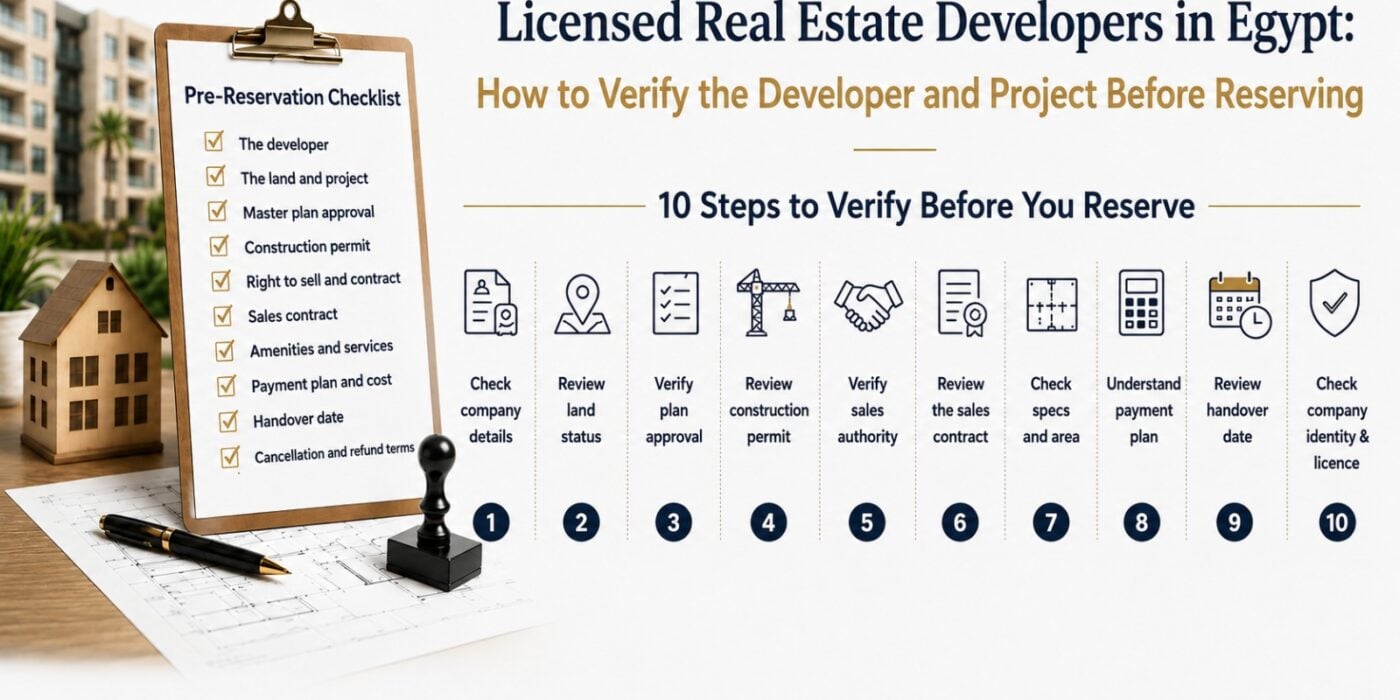
Searching for a list of licensed real estate developers in Egypt may be one of the first steps a buyer takes before reserving a new property. However, recognising the developer’s name alone is not enough to confirm that a project is legally compliant or ready for sale.
A registered real estate company does not automatically mean that every project it develops has the same legal status, or that every phase has obtained the same approvals. Buyers therefore need to verify the company, land, project, phase, individual unit and sales contract separately.
This guide covers the key steps that can help you assess a real estate developer before making a reservation, the documents and questions worth reviewing, and a practical example using Belva by Karnak Real Estate Developments.
The guide is divided into two main parts:
- An indicative list of 10 real estate companies whose names appear in sources published by the Real Estate Development Chamber.
- 10 practical steps to help you verify the developer, project and relevant documentation before reserving a property.
10 Real Estate Developers Mentioned in Real Estate Development Chamber Sources
In February 2025, the Real Estate Development Chamber published an official statement announcing the results of its board elections. The statement named the companies represented by several board members, including businesses classified among large and medium-sized enterprises. The Chamber subsequently announced the appointment of executives from other companies to its board.
Based on these sources, the following companies can be presented as an indicative list:
| # | Real Estate Developer |
| 1 | Arabia Holding |
| 2 | Tameer – Housing and Development Real Estate Investment |
| 3 | Emaar Misr |
| 4 | Ammar Real Estate |
| 5 | Misr Italia Properties |
| 6 | Redcon Properties |
| 7 | Polaris International Industrial Parks |
| 8 | El Bostany Real Estate Investment |
| 9 | Mountain View Real Estate Investment |
| 10 | Castle Development |
The Real Estate Development Chamber states that its membership procedures require companies to submit documents including the company gazette or articles of incorporation, a valid and recent commercial registration, a tax card, and details of the company’s legal representative. These documents are then reviewed before membership is approved.
The Chamber also announced in March 2026 that its permanent membership had reached 2,480 companies by the end of 2025, following the addition of 764 new companies during the year.
An Important Note About Lists of Real Estate Developers
This is an indicative list based on publicly available information from professional and official sources at the time of writing. It is not a comprehensive government register, nor should inclusion be interpreted as legal certification that every company listed has obtained all licences and approvals required for every project it develops.
A company appearing in sources published by the Real Estate Development Chamber does not automatically mean that every project or phase belonging to that company is licensed or has received every required approval. Buyers should independently verify the documents relating to the developer, project and specific unit they intend to purchase, preferably with the assistance of an independent property lawyer before reserving or signing.
Why Is a List of Real Estate Companies in Egypt Not Enough?
Searching for real estate company names in Egypt may seem like a sufficient first check, but in reality, it is only the beginning.
There is an important difference between:
A legally registered company↓
A company registered to operate in real estate development↓
A company with an established track record↓
A company that owns land or holds development rights↓
A project with the required approvals↓
A phase or building with the relevant construction permit↓
A unit that can be sold under clear documentation and contractual terms
The question, therefore, should not simply be:
“Does this company legally exist?”
You should also be asking:
“What is the legal and construction status of the project and the specific property I intend to buy?”
It is also important to remember that the commercial brand used in advertising may differ from the company’s registered legal name.
A simple rule to follow is this: do not pay an individual or company merely because its name appears in the project’s advertising. First confirm its legal relationship with the developer and the project.
10 Steps to Verify a Real Estate Developer Before Reserving
1. Verify the Company’s Legal Name
Start by identifying the company’s full legal name rather than relying solely on the commercial name used in advertisements.
Ask for information about:
- The company’s legal name.
- Commercial registration.
- Registered business activity.
- Legal representative.
- Registered company address.
- The legal entity that will sign the sales contract with you.
There should be a clear match between the party you are dealing with and the party named in the relevant sales documentation.
2. Check the Commercial Registration
A valid commercial registration can help confirm that the legal entity exists and provide access to some of its fundamental company information.
Do not rely solely on seeing the company’s name in an advertisement or on social media.
Ask to review the relevant official information and check:
- The registered company name.
- Business activity.
- Legal status.
- Legal representative.
- Other core company information.
3. Is the Company Registered on the NUCA Portal?
For developments located within Egypt’s new cities, the New Urban Communities Authority (NUCA) provides an online portal for investor services. The portal includes a service titled “Company Registered on the Portal”, alongside services relating to land opportunities and investor applications.
There is, however, an important distinction to remember:
Registration on the portal is not a substitute for examining the documentation of the project itself.
It can form part of your due diligence, but should not be treated as standalone evidence that every project or unit belonging to the company has fulfilled all applicable legal requirements.
4. Verify the Developer’s Legal Relationship With the Land
Once you have checked the company, turn your attention to the project itself.
Ask:
- Who owns the land?
- Does the developer own the land directly?
- Was the land allocated to the company?
- Is there a partnership agreement?
- Is the company the direct developer?
- Which document establishes the company’s right to develop the project?
This matters because the developer’s brand name does not, by itself, establish the company’s legal relationship with the land.
5. Check the Project’s Approvals
A registered company does not automatically mean that every development under its name has obtained all required approvals.
Ask for information relating specifically to the project, including:
- Master plan approval.
- The legal status of the land.
- Project-specific approvals.
- Land allocation decisions, where applicable.
- Documentation relating to the particular phase in which you intend to buy.
Rather than accepting the general statement:
“The project is licensed.”
Ask more specific questions:
“What is the name of the document? Which authority issued it? Which phase does it cover?”
6. Verify the Construction Permit for the Phase or Building
In large developments, not every building or phase will necessarily have the same construction or legal status at the same time.
You should therefore identify and verify:
- The phase number.
- The building number.
- The construction permit.
- The permitted number of floors.
- The unit’s position within the approved plan.
- The unit’s stated area.
- Whether the unit corresponds with the approved plans.
This is where the distinction between the project’s overall status and the documentation relating specifically to the building or phase you are buying into becomes particularly important.
7. Confirm the Company’s Right to Sell the Unit
Some developments involve several different parties:
Landowner → Developer → Sales Company → Marketing Company
Having several parties involved is not necessarily a problem. What matters is that the relationship between them is transparent and properly documented.
Before making any payment, ask:
Who will sign the sales contract with me?
Who will issue the payment receipt?
What is the relationship between the sales company and the developer?
Which document proves that the party I am dealing with has the right to sell this unit?
The clearer and better documented the answers are, the better informed your decision can be.
8. Review the Sales Contract Before Paying a Reservation Deposit
The day you sign the contract should not be the first time you see it.
Ask for a copy in advance and review:
- The total unit price.
- Unit area.
- Contractual handover date.
- Any grace period.
- Payment schedule.
- Maintenance deposit or maintenance fees.
- Utilities.
- Parking, where applicable.
- Cancellation terms.
- Resale or assignment conditions.
- The buyer’s rights in the event of a delay.
The most important rule is simple:
Any promise that materially affects your purchasing decision should not depend solely on a verbal assurance.
If a point matters to your decision, ask for it to be clearly reflected in the contract or relevant official documentation.
9. Confirm the Handover Date and How It Is Calculated
The handover date is one of the most important contractual points to examine when buying into an under-construction development.
Do not simply ask:
“When will the project be delivered?”
Instead, ask:
- What is the contractual handover date?
- From which date does the delivery period begin?
- Is there a contractual grace period?
- What rights does the buyer have in the event of a delay?
- Does the delivery date vary between phases?
Your decision should ultimately rely on the handover date stated in the contract, rather than only on a date mentioned in advertising material or a sales presentation.
10. Have an Independent Lawyer Review the Documents
Even when dealing with an established company that has completed previous developments, reviewing the project documentation and sales contract with an independent lawyer remains an important step, particularly when purchasing an off-plan or under-construction property.
A lawyer can review:
- The company’s legal status.
- The developer’s relationship with the land.
- Project-specific documentation.
- The sales contract.
- The obligations of both parties.
- Delay provisions.
- Cancellation terms.
- Assignment and resale conditions.
Most importantly, the lawyer should be independent of both the developer and the sales company so that the review is conducted in the buyer’s interest.
How Can You Apply These Checks to Karnak Real Estate Developments?
If you are considering buying from Karnak Real Estate Developments, you can apply the same checklist to the project you are interested in rather than relying on the company name alone.
For Belva in Sheikh Zayed, for example, buyers can begin by reviewing the available information about the development and their preferred unit, then request the latest available project information and documentation from the sales team before making a reservation.
Before Reserving a Unit at Belva, Ask About:
- The details of the company that will sign the sales contract.
- Available land and project documentation.
- Approvals and permits relating to the relevant phase.
- The building in which the unit is located.
- The final unit area and layout.
- The current stage of construction.
- The handover date stated in the contract.
- The total purchase price and payment plan.
- Maintenance and utility charges.
- Reservation and refund conditions.
- A copy of the contract before signing.
You can explore further details about Belva in Sheikh Zayed and review the available units before speaking with the sales team.
What Documents Should You Request Before Reserving?
Use the following checklist when speaking with a developer or sales company:
| Document / Information | Why Do You Need It? |
| Company legal details | To confirm the identity of the entity you will contract with |
| Commercial registration | To verify the company’s details and registered activity |
| Land documentation | To understand the developer’s legal relationship with the land |
| Land allocation decision, where applicable | To verify the basis on which the land is held |
| Master plan approval / relevant approvals | To understand the project’s planning status |
| Construction permit | To verify the relevant building or phase |
| Unit plan | To confirm the area and location of the unit |
| Draft contract | To review the rights and obligations of both parties |
| Payment schedule | To understand the total cost and your payment obligations |
| Contractual handover date | To establish the agreed delivery timeline |
Note: Required documents and competent authorities can vary from one project to another. You should therefore review the actual documentation relating to the development you are considering rather than relying solely on a general checklist.
Warning Signs to Watch for Before Buying Property
Take additional care if you encounter any of the following warning signs:
Refusing to Provide a Draft Contract Before Reservation
If the contract is central to your purchase decision, it is reasonable to ask for an opportunity to review it before committing.
Relying on Verbal Promises
For example:
“The unit will be handed over ahead of schedule.”
Or:
“You won’t have to pay that fee.”
If the information materially affects your decision, ask for it in writing.
Uncertainty About Which Company You Are Contracting With
You should know exactly which legal entity will be the other party to your contract.
Pressure to Make an Immediate Purchase Decision
A limited-time sales offer should not prevent you from reviewing the essential documents before committing.
An Unclear Handover Date
This is particularly important for projects that are still under construction. Make sure you understand the delivery date agreed in the contract.
Does Choosing a Well-Known Developer Mean the Project Is Safe?
Not necessarily.
A company may have a strong track record, but your final purchasing decision should still be based on:
The project + the phase + the unit + the documentation + the contract.
Knowing the names of established real estate developers in Egypt can therefore be useful when beginning your comparison, but it should never be the final step before purchasing.
An informed buyer does not ask only:
“Who is the developer?”
They also ask:
“What can I independently verify about the development in which I am buying?”
A developer’s track record can help you evaluate its experience and delivery capability, but it does not replace due diligence on the new project itself.
If you would like to compare developers based on their track records and presence in the Egyptian property market, you can also read:
Top 10 Real Estate Developers in Egypt – Comparing Track Records and Projects
Frequently Asked Questions About Licensed Real Estate Developers in Egypt
Is There One Official List of All Licensed Real Estate Developers in Egypt?
You should not rely on a single list of company names as sufficient evidence that purchasing in a particular project is legally sound. The company, project, land, relevant permits and sales contract should each be checked separately.
How Can I Check Whether a Real Estate Developer Is a Legal Company?
Start by reviewing the company’s legal information, including its official name, commercial registration, registered activity and legal representative. You should then move on to checking the documentation relating specifically to the development you are considering.
Does Commercial Registration Mean the Project Is Licensed?
No. The company’s registration is separate from the legal status of its land, the project itself, applicable approvals and the construction permits relating to individual phases or buildings.
What Does “A Real Estate Developer Approved by the Ministry of Housing” Mean?
Rather than relying on the phrase as a general claim, ask which specific document or approval is being referred to. A land allocation decision, master plan approval and construction permit are separate documents and should not be treated as a single form of approval.
Can I Buy a Unit Before the Project Is Completed?
Properties can be purchased in developments that are still under construction, but this makes careful review of the project documentation, relevant phase, contractual handover date and sales terms particularly important before reserving.
Does a Developer’s Track Record Matter?
Yes. Previous developments can help you assess a developer’s experience and execution capability. However, a strong track record does not remove the need to verify the specific project in which you intend to purchase.
Should I Have the Sales Contract Reviewed by a Lawyer?
It is advisable to have a property purchase contract reviewed by an independent real estate lawyer, particularly when purchasing an under-construction unit or entering into financial commitments that extend over several years.
Conclusion
Finding a list of licensed real estate developers in Egypt is not the end of your research. It is simply a starting point.
Before paying a reservation deposit, separate your due diligence into four different questions:
- Does the company legally exist and operate under the relevant registered activity?
- Does it have the legal right to develop the project?
- Do the project and the relevant phase have the necessary documentation and approvals?
- Does the unit’s contract clearly protect your rights and define your obligations?
Once you have addressed these questions, you can move on to comparing price, location, design, payment plans and developer track record with greater confidence.
If you are considering purchasing at Belva by Karnak Real Estate Developments, request the latest available information about the project, your preferred unit and the relevant documentation before reserving. Compare the development with other options using the same criteria, and have the sales contract reviewed by an independent property lawyer before signing.
Find the Right Belva Home for You
Request the latest Belva details and let our team help you identify a suitable unit and payment plan for your needs.