
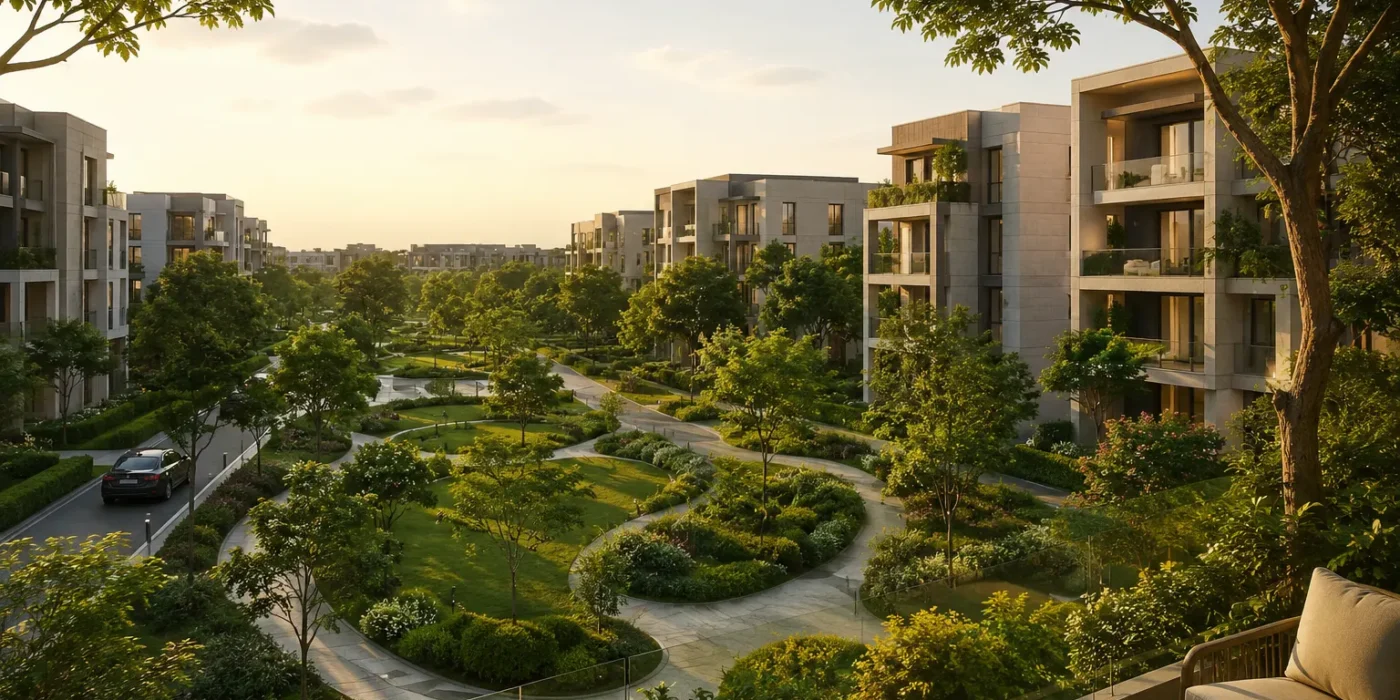
When you search for a home, the word “peaceful” appears everywhere. But real peace isn’t something that goes in a brochure — it’s built into the earliest design decisions and felt every morning, before the rest of the world wakes up.
Visit any compound and you’ll hear the same pitch: “It’s wonderfully quiet, completely removed from the noise of the city.” The sales agent delivers the line with a reassuring smile — and a year later, you find yourself complaining about the traffic on the internal road, the echo from the elevator shaft in the next building, and the fact that the garden turned out to be decoration rather than a real buffer.
Quiet inside a compound isn’t a promise made in a showroom. It’s the calculated outcome of far-reaching decisions made at the engineer’s table long before the first concrete is poured. It’s determined by the width of internal pathways, how buildings or units are distributed, the size and functional logic of green spaces, the angle of windows, and the flow of vehicle movement throughout the project.
What you experience every day when you come home is a direct reflection of choices a planner made years before you ever heard of the development. This article takes you behind the polished facades — into the design logic that either creates genuine quiet, or fails to deliver it entirely.
Quiet Isn’t a Feeling — It’s a Measurable Design Standard
Before we talk about Belva or any specific project, there’s a foundational truth worth establishing: quiet is a measurable urban phenomenon. Urban design researchers quantify it in decibels and map noise dispersion before a single floor plan is drawn. Any development that claims quietness without a planning rationale to back it up is simply offering promises with no substance.
Once you understand that quiet has an equation, you start asking the right questions on every compound visit: Where are the entrances? How are the buildings arranged? What is the actual — not just the rendered — area of green space? Each answer will lead you to a real verdict on the quality of life waiting for you.
Building Density and the Distance Between Units
One of the most telling indicators of genuine quiet inside a compound is the ratio of built area to total project land. When residential units are packed tightly into a limited footprint, it’s not just privacy that disappears — mutual noise levels rise sharply. Neighbors’ conversations, cars returning late at night, the sounds of overlapping play areas bleeding into spaces meant for rest: all of it compounds when buildings sit too close together.
Projects that commit from the start to a lower building density in favor of functional open spaces are far better equipped to provide adequate distances between buildings — distances that act as natural sound barriers and give each unit a clear sightline that doesn’t end at a neighbor’s wall.
Traffic Flow and Its Impact on Noise Levels
Internal movement inside a compound has its own acoustic signature. Cars threading through narrow roads that cross pedestrian zones reshape the compound’s entire noise map. Developments that separate vehicular and pedestrian movement — with dedicated paths, and parking kept well away from quiet residential areas — give residents a meaningful buffer of calm, even during peak hours.
Building Density
The lower the ratio of built area to total land, the greater the potential for quiet and privacy in every unit.
Pedestrian-Vehicle Separation
Dedicated pedestrian paths mean movement without noise — and automatic safety for your children at all hours.
Façade Orientation
Windows facing internal green spaces rather than streets reinforce a calm visual experience that carries through every day.
Green Space in Sheikh Zayed: Visual and Psychological Buffer Before It’s Beauty
When green spaces in Sheikh Zayed compounds come up in conversation, most people picture a small side garden or a row of trees planted along the perimeter wall. But green space that’s genuinely designed — not just placed — works on three levels simultaneously: aesthetic, acoustic, and psychological. That layered function is what separates developments that plant trees from those that engineer environments.
In projects that treat green space as a living, considered element, what you end up with is a compound that is authentically quiet — not just visually appealing. Mature trees absorb sound. Dense groundcover traps dust. Open lawns create transitional zones between public and private life. This isn’t luxury — it’s a complete psychological infrastructure.
Green Space as Acoustic Buffer: What the Research Shows
Urban planning research has demonstrated that dense, multi-layered planting — tall canopy trees above mid-height shrubs above ground-level groundcover — can reduce external noise by anywhere from eight to fifteen decibels. That’s a perceptible difference in daily living. This natural barrier requires no electricity, no expensive maintenance, and only grows more effective as the trees mature over the years.
When a compound is designed so that green spaces wrap around the residential units rather than being tucked away in a corner, every window becomes a frame for a natural view — and the home becomes a genuine refuge from the noise of the city.
Thoughtfully designed greenery doesn’t just improve a compound’s appearance — it rewires how its residents relate to daily stress. You stop being someone who comes home to a unit. You become someone who comes home to an environment.
— Environmental Design Principle in Residential ProjectsGreen Space as Psychological Buffer: Nature and Mental Calm
The role of green space doesn’t stop at acoustics. Environmental psychology research shows that simply looking at a green view from a window for twenty minutes a day measurably reduces cortisol — the body’s primary stress hormone. Nature engages the most ancient, restorative part of our brain, offering a genuine recovery from the visual fatigue of work screens and a relentlessly loud city.
A compound that places this understanding at the center of its design isn’t selling you an apartment or a villa — it’s selling you daily quality of life. You feel it on the balcony in the morning, and you feel it on the drive home after a long day, when the pressure begins to ease before you’ve even reached your front door.
Belva Compound Sheikh Zayed: Where Quiet Becomes a Deliberate Daily Experience
Those searching for a quiet compound in Sheikh Zayed often ask the same question: is the calm you hear about in the marketing real, or is it just positioning? The answer lives in the details visible on the master plan — not in verbal assurances. Belva answers that question through clear planning logic that you can read on paper before you ever visit the site.
What sets Belva apart from many competing projects is that it didn’t start with the question of how to fit as many units as possible into the least amount of land. It started with the harder question: how does a Belva resident experience an ordinary day at the highest possible quality? That shift in the founding question is what produces a genuinely different outcome.
Building Distribution and Considered Privacy
At Belva, the arrangement of buildings achieves a careful balance between residential density and quality of life. Units are positioned so that no window faces another unit’s window directly — making privacy an automatic condition rather than something that depends on keeping the curtains drawn.
The gaps between buildings serve more than just circulation. They carry a combined acoustic and visual function: limiting the transfer of everyday sound between units, while giving every resident an open sightline toward greenery and the internal open space. These aren’t aesthetic details — they are planning decisions that make residents feel free rather than hemmed in.
Core idea: When a Belva resident’s sightline doesn’t end at another wall or a neighbor’s window, that openness has a direct impact on daily mental wellbeing. Visual openness isn’t a luxury — it’s one of the fundamental conditions for real quiet inside a compound.
Green Spaces at Belva: Designed to Be Lived In, Not Photographed
What the Belva master plan makes clear is that the green spaces weren’t conceived to look good in aerial photography. They were designed to be part of daily life. The central green areas run through the heart of the development — not along its edges — meaning every resident, regardless of their unit’s location, has genuine access to a green outlook and open air.
Walking paths within the green spaces are part of the original design, not a later addition. That means the relationship between people and nature at Belva is woven into residents’ daily rhythms: a morning walk, an evening with family, children playing somewhere safe and visible from home. These moments sound simple — but they are the core of what makes life in a genuinely quiet compound a qualitatively different experience.
Traffic Separation and Internal Noise Management
Perhaps nothing is more overlooked by buyers negotiating over a unit than the internal vehicle route. At Belva, vehicular movement is designed so that it doesn’t cross through quiet residential zones, and parking is positioned away from key gathering areas and bedroom windows. The result is quieter nights and calmer mornings — a difference you feel every day without necessarily knowing its source.
The intersection of these decisions — building layout, depth of green space, and internal traffic management — is what produces quiet as a compound-wide condition rather than an isolated feature. Belva reflects a clear understanding of that equation.
Why Buyers Should Ask About Planning Before They Ask About Finishes
Many buyers spend hours comparing flooring materials, ceiling heights, and the quality of fixtures — all of which are real and relevant considerations, but none of which determines daily quality of life over the long term.
Once the initial excitement settles, what remains is your relationship with the space around you: the neighbor, the noise, the air, the light. And all of that is determined by planning, not by interior design.
The family looking for a calm environment for their children, the professional who needs a genuine boundary between work and home, the couple seeking real privacy — they are all ultimately looking for a project that answers the planning question with confidence, not promises.
Questions to Ask Before You Sign
The most valuable information you can gather on a site visit isn’t inside the glossy brochure — it’s in the answers to these questions: What is the ratio of built-up area to total project land? Does the internal vehicle road pass near the residential units? Where exactly is the main entrance relative to your specific unit? What is the actual square footage of green space surrounding your unit — in meters, not in words?
Projects with clear, evidenced answers to these questions are genuinely selling quiet. Those that redirect you toward façade aesthetics and price per square meter are selling a surface, not a quality of life.
Request the Master Plan
The actual layout reveals what marketing imagery can’t: building density and how open space is distributed.
Check Where the Green Space Is
Central green space surrounding the units is far more valuable than a garden tucked at the edge of the project.
Trace the Vehicle Route
Ask where the internal road runs — and confirm it doesn’t pass directly in front of bedroom windows.
Conclusion
When you choose a home, you’re not choosing four enclosed walls — you’re choosing a complete environment whose details you’ll live with every day for years. The quiet you’re looking for doesn’t come from a sales pitch or a brochure photograph. It comes from decisions made at a design table years before you ever knew the project existed.
Belva Sheikh Zayed answers that logic in the language of planning: a building layout that protects privacy, central green spaces that serve as visual, psychological, and acoustic buffers, and internal traffic management that keeps noise away from rest areas. These aren’t promises — they are decisions readable on the master plan and felt in daily life.
If you’re looking for a quiet compound in Sheikh Zayed that turns quality of life from a slogan into a daily reality, the plan in front of you is the most honest question you can ask — and Belva has the answer ready.
See Belva’s Master Plan and Space Distribution
Download the full project profile — complete with the master plan, unit layout, and green space breakdown — and judge for yourself.
Download the Compound BrochureFrequently Asked Questions
How can I tell if a compound is genuinely quiet before I buy?
The most reliable approach is to study the project’s master plan: check the ratio of built area to total land, the location of internal vehicle roads, and how the green spaces are distributed. It’s also worth visiting the development at different times — morning, evening, and on a weekend — to measure actual noise levels rather than estimated ones.
What specifically makes Belva Sheikh Zayed a quiet compound?
Belva is built on three planning pillars: buildings spaced far enough apart to guarantee privacy and sound insulation; central green spaces large enough to function as multi-purpose natural buffers; and a clear separation between vehicle routes and quiet residential areas. Together, these decisions produce a daily quiet that’s tangible — not a marketing claim.
How do green spaces affect a unit’s investment value over time?
Well-managed central green spaces are among the most powerful drivers of long-term property value retention and growth. International real estate studies consistently show that units with green outlooks achieve notably higher resale values compared to equivalent units in densely built projects with no genuine internal greenery.
Is Belva Compound suitable for families with young children?
Belva is very well suited to families. The clear separation between vehicle routes and pedestrian areas creates automatic safety for children without requiring constant, exhausting supervision from parents. The internal green spaces allow children to play in an open, secure environment that remains visible from the residential units — one of the most important selection criteria for many families.
What unit options are currently available at Belva?
Belva includes a diverse range of residential units suited to both families and working professionals, with a variety of sizes and finishes. For current availability, pricing, and delivery details, contact the Karnak team directly or download the project profile using the link above.