

When you buy a unit in a new residential development, you are not simply buying an apartment, a certain amount of space and a view. You are entering a journey that began long before the project was first marketed, shaped by decisions around the land, feasibility, design, approvals, project partners, construction and operations before ultimately reaching the handover of your unit.
That is why a real estate development project should not be assessed on price or final renders alone. A more informed buyer looks for something more valuable: evidence that reflects the stage the project has actually reached. If it is still in the design phase, what demonstrates the clarity of the vision? Once construction begins, who is overseeing the work? And as handover approaches, what indicates that the infrastructure, services and operations are being prepared?
This approach becomes particularly important when assessing an under-construction development such as Belva Sheikh Zayed by Karnak Real Estate Development. Belva is no longer simply an architectural concept; construction has already begun, and announced partners are involved in areas relating to design, execution and digital infrastructure. This allows you to move beyond asking, “What is the project promising?” and ask a more useful question instead: “What evidence supports the stage it has reached?”
If you are comparing different real estate development projects, this distinction can fundamentally change the way you make your decision. Don’t judge progress by a percentage alone; ask what evidence supports it.
What Is a Real Estate Development Project, Really?
Real estate development goes far beyond construction. A building is one of the outcomes of the development process, but that process begins much earlier with identifying the opportunity presented by the land, studying market demand, defining the property product, architectural planning, securing the required approvals, selecting the parties involved in the project, and then managing execution through to operations and handover.
Development Is Not the Same as Contracting
A contractor is responsible for a defined scope of construction work, while the developer manages the bigger picture. The developer connects the land, market, product, financing, design, contracts, execution and customer experience. When assessing the company you are buying from, it therefore makes sense to look at its ability to manage this entire ecosystem rather than judging it solely by the appearance of its buildings.
For the same reason, reviewing the developer’s track record and the evidence linked to construction and delivery can help you make a more meaningful comparison than relying on a company name or the scale of its marketing campaign alone.
Why Are Different Types of Real Estate Development Assessed Differently?
Types of real estate development include residential, commercial, administrative and mixed-use projects, among others, and each comes with different design and operational requirements. A residential development, for example, should not be judged by the number of units alone. Building placement, privacy, internal circulation, everyday services, open spaces and the project’s ability to sustain a high-quality living environment after residents move in all matter.
This is particularly relevant when looking at Belva as a residential community in Sheikh Zayed. The development extends across 18.5 feddans and comprises 21 buildings, with a substantial proportion of the site dedicated to greenery and open areas.
Development here is therefore not simply about constructing individual buildings, but about delivering an integrated residential master plan whose different elements ultimately need to work together.
The Real Estate Development Process: 8 Verification Checkpoints Before Handover
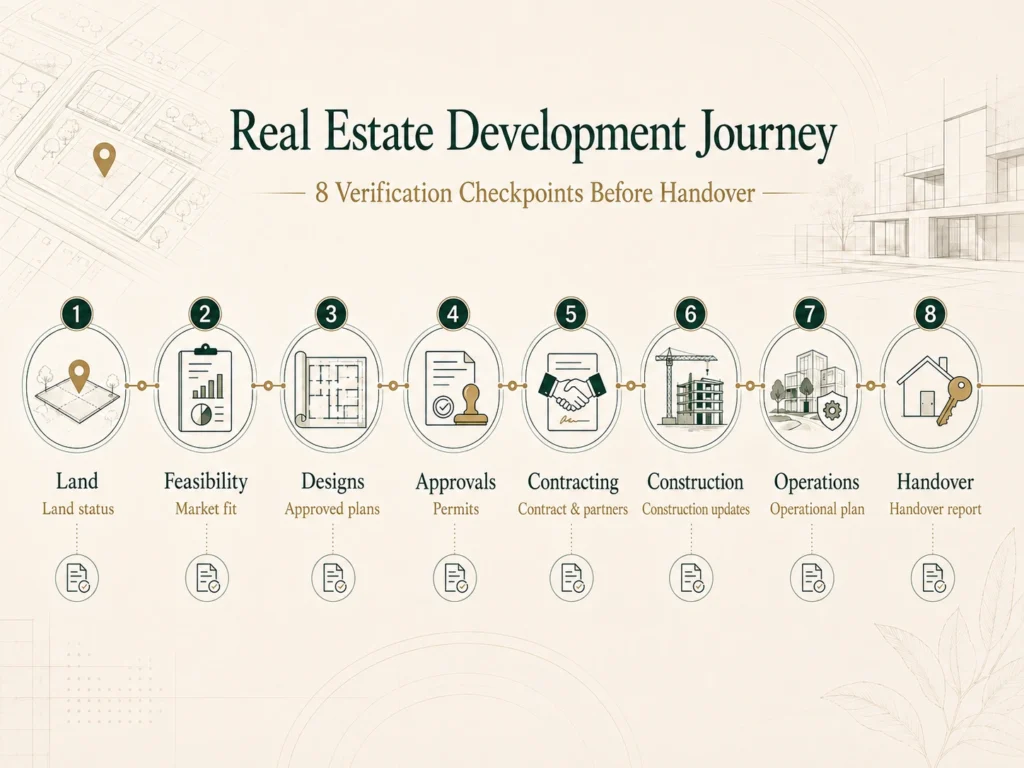
You can think of the development journey as a series of checkpoints. At each one, an important decision has been made, and there should be a corresponding document, piece of information or form of evidence appropriate to that stage.
This does not mean every internal or commercial document must be handed to the buyer, but you should be able to obtain a reasonable level of clarity before making a major financial commitment.
| Stage | The Question That Matters to You | Evidence or Information to Verify |
| Land | Is there a clear basis for developing the project on this land? | The legal status of the land and the relevant development or allocation rights according to the nature of the project |
| Feasibility | Does the product fit the market and location? | Clarity around the product, unit sizes, target residential segment and overall pricing position |
| Design | Who designed the project, and what is the approved vision? | The master plan, designs and announced architectural parties |
| Approvals | Has the project legally progressed to the appropriate stage of execution? | Approvals and permits relevant to the scope of work underway |
| Contracting | Who is involved in turning the vision into reality? | Project partners, consultants and their respective areas of responsibility |
| Construction | Is there tangible progress that can be tracked? | Activity on site, documented updates and technical supervision |
| Operations | How will the community function once completed? | Plans for utilities, infrastructure, services and operations |
| Handover | Will what you receive match what you contracted for? | The contract, unit specifications, handover procedures and relevant handover documentation |
These checkpoints lie at the heart of a buyer-focused real estate development process: each stage should answer the questions relevant to that particular point in the journey rather than using a single indicator, such as a “completion percentage”, to judge the development as a whole.
Checkpoint One: Land and Feasibility Before Construction Begins
Some of the most important decisions are made long before excavation begins. The choice of land helps determine what type of property product can be developed, who is likely to want to live or invest there, and how the surrounding road network and services may support the development in the future.
Land Is More Than a Good Address
As a buyer, you should first consider the project’s location as part of its practical value. Can you reach your workplace and everyday services conveniently? Is there genuine residential demand in the area? And does the location support the lifestyle you are planning, rather than simply looking attractive on a map?
In Belva’s case, you can assess how accessible Belva’s Sheikh Zayed location is and consider its relationship with key routes and nearby landmarks rather than judging the location by the area name alone.
What Does a Feasibility Study Mean for a Buyer?
You would not normally receive the developer’s internal commercial feasibility study, nor do you need it in order to make an informed decision.
What matters is being able to see its outcomes in the product itself: practical unit sizes, a considered mix of properties, a location suited to the intended market, services with a clear purpose, and pricing and payment plans that make sense in relation to the value of the development.
This stage helps distinguish a development shaped around a genuine market need from a property product focused primarily on fitting the greatest possible number of units onto a plot of land.
Checkpoint Two: From an Attractive Design Concept to an Executable Master Plan
Architectural renders can capture attention, but they are not enough to assess the quality of planning. What matters is whether there is a clear architectural vision explaining how the buildings, open spaces, internal movement and services work together, and how individual units relate to the wider community.
At Belva, Design Is Part of the Project’s Identity
Belva carries the architectural vision of Raef Fahmi and is planned as a residential community that balances built space with open areas. That distinction matters because the value of good design is not limited to the façade. It influences how the development feels as you move through it, the privacy between buildings, natural light, views and the way different spaces are used.
However, having a recognised architect does not remove the need for verification. Ask to understand the master plan, the location of your chosen building, the orientation of the unit, the surrounding spaces and where major amenities are positioned. This turns design from a marketing feature into a practical tool for choosing the right property.
Checkpoint Three: Approvals and Contracting Before Construction Accelerates
This is where the vision begins moving from planning into a more defined commitment to execution. As the development progresses, it becomes increasingly important to know not only “Who is the developer?” but also “Who is responsible for each part of the project?”
Why Do the Developer’s Project Partners Matter?
An integrated development requires several areas of specialist expertise. The architect does not perform the role of the executive consultant, and the consultant does not perform the role of a telecommunications provider. Each party contributes a different layer to the final product.
Understanding the role of each real estate development partner can therefore help you determine whether those partnerships address meaningful functions within the project or are simply names with little relevance to your future experience as a resident.
Where Do Real Estate Development Contracts Fit into Your Decision?
The term real estate development contracts can cover several levels of contractual arrangements throughout the development process. For you as a buyer, however, the agreement governing the purchase of your own unit remains the primary reference point.
You should understand exactly what you are buying, the unit price, payment schedule, contractual handover date, specifications, principal obligations and any annexes associated with the transaction.
Do not allow the commercial offer to substitute for the contract. The offer explains the opportunity; the contract defines the obligations. If any clause is unclear or could have a significant legal or financial impact, it is advisable to review it with your legal adviser before signing.
Checkpoint Four: Construction — Where the Evidence Becomes Visible
Construction is an important stage, but it is not where the development story begins. Rather than treating it simply as a series of excavation and concrete works whose technical names buyers are expected to learn, it is more useful to view construction as a verification checkpoint: have the plans, appointments and commitments actually translated into activity that can be followed on site?
Belva Can Now Be Assessed on More Than Architectural Renders
Karnak Real Estate Development has announced the start of construction at Belva, which means buyers can now assess the project using forms of evidence that were not available at launch. The key question is no longer simply, “Will construction begin?” It becomes: “What stage has the project reached, what has been completed, and who is overseeing the quality of the work?”
If you want to understand what different construction-site images actually represent, you can understand the stages of residential construction and interpret site updates more accurately.
ICO Adds a Technical Layer of Verification
One of the announced indicators at Belva is Karnak Real Estate Development’s appointment of ICO Engineering Consultants as the project’s executive consultant. The value of this step is not simply in the name attached to the agreement, but in its function: involving a specialist engineering party in following the works, reviewing aspects of execution and supporting quality control.
You can learn how an executive consultant contributes to project quality control if you want to assess this partnership from a buyer’s perspective rather than viewing it simply as an engineering appointment.
Checkpoint Five: From Construction to Operations
A successful development does not end when the façades are complete. You will ultimately be living in a community that requires water, electricity, telecommunications, security, maintenance, management of shared spaces and everyday services. Operational planning therefore deserves to be considered long before you receive the keys.
Verify Quality and Infrastructure, Not Aesthetics Alone
When assessing residential real estate development projects, ask about infrastructure and services with the same seriousness you apply to landscaping and façades. A clear plan for utilities and infrastructure can later influence both quality of life and the community’s ability to maintain its appeal.
At Belva, Karnak Real Estate Development’s agreement with Vodafone Egypt to provide telecommunications and digital infrastructure solutions within the development is an example of planning for part of the post-construction resident experience.
It does not mean every operational detail is already finalised, but it does provide an announced element that can form part of your assessment rather than relying on general promises of “smart living”.
Checkpoint Six: Handover Is Where the Contract Meets Reality
At handover, the comparison between what you contracted for and what you actually receive becomes fundamental. This is where the specifications, timing, condition of the unit, financial procedures and any documentation associated with completing the handover come together.
Review the Unit Against the Contract, Not Your Memory
When signing real estate development contracts or unit purchase agreements, retain a clear copy of the contract, its annexes and the agreed specifications. At handover, use these documents as the basis for your review rather than relying on what you remember from the original sales presentation or verbal discussions.
This is not a pessimistic approach. It is a normal practice that helps maintain clarity in the relationship between buyer and developer. The objective of any organised development process should be to reach a point where the buyer can compare the delivered product with what was agreed from the outset.
Belva as a Case Study: What Can You Verify Today?
Belva’s strength from this perspective does not come from suggesting that its development journey is already complete. It comes from having announced milestones that you can use to assess that journey as it progresses. For a buyer, this is more useful than treating the project as a finished future image that cannot be examined or questioned.
There Is a Clear Project Vision
You know that Belva is a residential development in Sheikh Zayed extending across 18.5 feddans and comprising 21 buildings, with significant attention given to landscaped and open spaces. Its design is also associated with architect Raef Fahmi, giving you a clear starting point from which to ask about the architectural vision and the layout of the development.
There Is an Announced Move into Construction
Karnak Real Estate Development has announced the start of construction, meaning Belva has entered a stage that can be followed through site updates rather than architectural renders alone.
At this stage, it can also be useful to assess whether buying an apartment under construction at Belva suits you based on your requirements, preferred waiting period and ability to follow the project’s progress, rather than treating “under construction” as inherently positive or negative.
There Are Announced Partners with Defined Roles
ICO Engineering Consultants is associated with the project’s execution and technical oversight, while Vodafone Egypt is associated with telecommunications and digital infrastructure solutions. These partnerships do not replace your responsibility to review your unit purchase agreement, but they do demonstrate that the project is being developed through a network of different specialisms rather than buildings alone.
Your Financial Decision Can Remain Flexible
Belva offers a range of payment plans depending on the available units and current offers, allowing you to balance your payment plan against your monthly budget before choosing a unit. Plans and availability are subject to change, so you should obtain the current offer directly from Karnak Real Estate Development when you are ready to make a decision.
How Does Karnak Real Estate Development Manage Belva’s Development Journey?
The essence of a developer’s role is to connect the different stages rather than treat them as isolated components. This becomes increasingly important as you move from seeing an advertisement for the project to considering a long-term property purchase.
From Planning to Partners and Execution
The approach visible at Belva brings together architectural design, the transition into construction, the appointment of an executive consultant and planning for digital infrastructure through a specialist partnership. For Karnak Real Estate Development, these elements give buyers more specific points around which to discuss and assess the project.
This is what you should look for in a real estate development process: each stage should connect logically with the next, allowing you to understand the relationship between what has been designed, what is currently being built and what is planned for future operation.
Useful transparency does not mean overwhelming buyers with engineering terminology. Ideally, the Karnak Real Estate Development team should be able to answer three questions clearly: Where is Belva today? What evidence supports that stage? And what comes next?
A Quick Due Diligence Checklist Before You Reserve in Any Development
No matter how appealing a project looks, give yourself one final verification step before turning your interest into a reservation. This checklist can help you prioritise your questions according to their real impact on your decision.
- Land: Ask about the project’s legal status and what can be verified before you sign.
- Location: Test the journey to the development yourself at the times that matter to you.
- Design: Identify your building, unit, orientation and view on the master plan.
- Construction: Ask for the latest update explaining the work currently underway rather than asking only for a general completion percentage.
- Partners: Know who is responsible for the design, technical supervision and major services.
- Contract: Review the price, payment schedule, handover date, specifications and annexes.
- Operations: Ask about the services and infrastructure that will affect your everyday life once you move in.
- Handover: Understand the handover procedure and what documentation will be used when inspecting your unit.
When comparing different real estate development projects, apply the same checklist to each one. This gives you a more balanced basis for comparison and reduces the risk of allowing an attractive price offer or polished final render to outweigh more important considerations.
Conclusion: Ask for the Evidence Behind the Percentage
The best way to assess a real estate development project is not to wait until it is complete and judge it retrospectively. You can make a more informed decision while the development journey is still underway if you know what to look for at each stage.
The land has its own verification checkpoint. The design should have supporting evidence. Approvals and contracts raise specific questions. Construction requires updates that can be connected with what is happening on the ground. Operations need planning, and handover should ultimately bring you back to what was agreed in your contract.
At Belva Sheikh Zayed, Karnak Real Estate Development is working on a project that has moved into active construction, supported by a defined architectural vision and announced partners across important areas of the development journey. So, if you are considering buying a unit, don’t make “send me the prices” your only first request.
Ask Karnak Real Estate Development for the latest information supporting Belva’s current stage of progress, then discuss the unit and payment plan that suit you with a clearer understanding of the project behind them.
Explore Belva’s Current Stage of Development
Don’t ask the sales team for a completion percentage alone. Ask Karnak Real Estate Development to explain Belva’s current stage, what evidence or update supports it, and what the next step in the construction journey will be.
Frequently Asked Questions About Real Estate Development and Belva
1. What Documents Should I Check Before Buying a Property Under Construction?
No single document replaces the need for a wider review. At Karnak Real Estate Development, we recommend starting with the contractual documents relating to your unit, the information supporting the project’s current stage, the agreed specifications, payment schedule and contractual handover date. If you require specialist legal advice, consult your lawyer before signing.
2. How Can I Tell Whether a Development Has Genuinely Moved into Construction?
Look for actual construction activity and official updates explaining the nature of the work underway rather than relying on a reported percentage alone. At Belva, Karnak Real Estate Development has announced the start of construction, and you can contact our team for the latest available information about the project’s current stage.
3. Are Construction-Site Photos Enough to Make a Buying Decision?
No. At Karnak Real Estate Development, we view them as supporting evidence rather than the whole basis for your decision. Site images should be considered alongside the location of your unit, your contract, the design, your payment plan and the stage of work represented by the images.
4. What Is the Difference Between a Developer, Contractor and Executive Consultant?
The developer manages the project journey as a whole, while the contractor carries out the agreed scope of construction works. The executive consultant performs technical duties related to following and reviewing execution within its defined scope of responsibility. At Belva, Karnak Real Estate Development appointed ICO Engineering Consultants as the project’s executive consultant.
5. Why Should I Pay Close Attention to the Contract Before Reserving a Unit?
Because the written terms govern the financial and contractual commitment you are making. At Karnak Real Estate Development, we recommend clearly understanding the unit, price, payment schedule, handover date, specifications and principal obligations before signing rather than relying on verbal discussions alone.
6. Do the Documents I Need to Review Differ According to the Type of Real Estate Development?
Yes. The nature of the development affects its services, operations, approvals and the elements that matter most to the buyer. Belva is a residential project, so in addition to the legal and contractual aspects, we recommend considering your unit, the master plan, shared spaces, services, infrastructure and the future residential experience.
7. Does Having an Executive Consultant Mean I No Longer Need to Follow the Project’s Progress?
No. The presence of ICO Engineering Consultants as Belva’s executive consultant is an important part of the project’s technical oversight framework, but it does not remove your role as a buyer in following updates, understanding the current stage and reviewing the obligations set out in your agreement with Karnak Real Estate Development.
8. How Should I Assess a Real Estate Development Process Before Buying?
Look at how the journey connects from one stage to the next. Is there a clear product vision? Are the relevant partners known? Has the project moved into construction? Can you understand both the current stage and what comes next? And do the unit, contract and payment terms suit your requirements? At Belva, the Karnak Real Estate Development team can explain these elements based on the latest available project information.
9. What Makes Belva Stand Out When Compared with Other Real Estate Development Projects?
At Karnak Real Estate Development, we see Belva’s strength in the combination of its Sheikh Zayed location, residential planning across 18.5 feddans, architectural vision, the start of active construction, the appointment of ICO Engineering Consultants as executive consultant, and the Vodafone Egypt partnership for telecommunications and digital infrastructure solutions. Choosing the right unit, however, should always depend on the individual buyer’s requirements and budget.
10. What Is the Best Question to Ask the Karnak Real Estate Development Team Now?
Start with this: “What stage has Belva reached, and what evidence is available to support it?” Then ask about the unit that suits you, its position within the development, the current payment plan and the contractual handover date. This allows you to begin with verification before moving on to comparison and purchase with a clearer basis for your decision.